RFE Response Drafting With AI in Immigration Law
AI consolidates nine manual steps into three automated stages while keeping attorneys in control.

- Written by
- Renata Solís-WexlerSenior Correspondent, Legal Technology
- Published
- October 12, 2026
- Reading time
- 11 min read
What this covers
A Request for Evidence lands on a desk with a fixed government deadline attached, and from that moment, the notice has to pass through at least nine separate manual handoffs before it ever reaches USCIS again: receipt, docketing, triage, evidence checklist creation, client document collection, internal task assignment, drafting and legal analysis, approval, and final submission. Every one of those handoffs is a place where a file can sit, a document can get misfiled, or responsibility for the next step can go unclear. The work itself asks for four things at once: fast evidence assembly, careful legal analysis, coordinated task tracking across paralegals and attorneys, and an approval process that holds up to scrutiny, all compressed into a calendar that does not move. Missed deadlines and inconsistent document collection are not small operational hiccups in this context; they translate into denied petitions and damaged client relationships. Attorneys who are skeptical that RFE drafting can be automated at all are not wrong to start from that assumption, since the legal reasoning embedded in a response is genuinely difficult, but the reasoning is only one part of the nine-step chain, and most of the hours lost happen before a lawyer ever applies judgment to the evidence in front of them.
The three-stage pipeline that AI automation follows
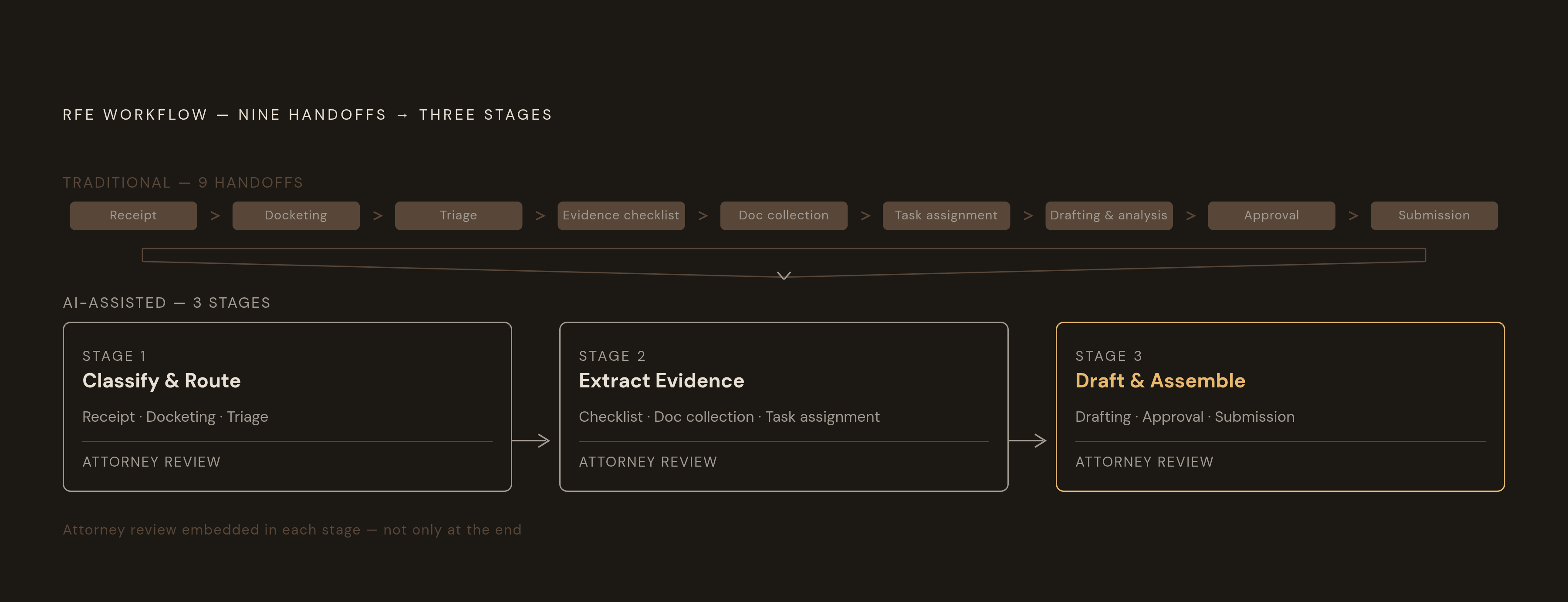
AI does not replace that nine-step chain with a single click. It reorganizes the chain into three stages, each with its own input and output: classifying the incoming notice and routing it to the right team, extracting evidence from client documents into a structured format, and generating a draft response along with the final submission packet. Attorney review sits inside each of these stages rather than at the very end, which is the detail that separates a well-built pipeline from a liability. The task at every step of this process is deciding which parts of a manual action can run on their own and which parts need a person to sign off before anything moves forward. Because the stages run in sequence, a mistake made in classification is not contained there; it reappears in extraction and again in the draft itself. That is why the real engineering decision in any RFE automation project is how the notice gets triaged in the first place, not how polished the draft templates look.
Stage one: classifying the notice and routing the matter
Classification determines nearly everything that happens afterward: which evidence template gets pulled, which deadline tracking rules apply, and which approval path the matter follows before it can be filed. Get this step wrong, and every stage downstream inherits the error. An AI model can read the notice text and pull out the facts that matter, the notice type, the subject matter, the stated deadline, and any language that suggests fraud or misrepresentation, then suggest a category. But the rules that decide what happens next belong in the firm's workflow system, written down and applied the same way every time, rather than left to a model's best guess in the moment. Put concretely: if the notice type carries high-stakes issues like fraud or misrepresentation, the matter escalates straight to lead counsel and automatic submission locks until a partner signs off. If the notice type is a standard RFE asking for routine documents, it goes to the paralegal team, a standard evidence checklist gets generated, and a service-level deadline gets set. High-stakes notice types need a separate track from ordinary RFEs built into these rules from the start, because that separation is what keeps the system from acting on its own in cases where it has no business doing so. Complexity matters as much as notice type: a request for pay stubs, tax records, or birth certificates is a strong candidate for automation further down the line, while a notice raising jurisdictional questions or fraud concerns needs a senior attorney's eyes immediately, no matter what documents it asks for. A well-built workflow template assigns high-risk notice types to a supervising attorney automatically, rather than relying on someone to remember to flag it later, because the routing rule itself functions as the safeguard. Other signals worth capturing at intake include how severe the deadline is, what language the client speaks, and whether this client has a history of recurring RFEs on a given matter. If the client's language is Spanish, for example, that should trigger multilingual client messaging and a document translation checklist as part of triage, not as an afterthought tacked on later.
Stage two: extracting evidence from client documents
The extraction stage produces the biggest and most immediate time savings in the whole pipeline, since AI takes over the job of reading through client documents by hand and labeling what matters. Optical character recognition and language models trained on immigration paperwork can recognize form fields, boilerplate language common to third-party documents, and dates or dollar amounts embedded in running text, then pull out specific fields: dates of employment, wage figures, beneficiary names, degree titles, employer contact information. Those extracted fields map onto variables in the draft template, so by the time an attorney opens the file, the response already contains a populated summary of the exhibits. The system should only auto-populate fields it is confident about; anything it is less sure of gets flagged for a person to check by hand. That design choice matters because it keeps the attorney in control of accuracy without forcing them to re-read every source document from scratch, which preserves the purpose of automating the step. The same extraction layer can label document types, pay stubs, employment verification letters, medical records, and organize them with timestamps and version history, building a chain of custody as a natural side effect of the process. Everything the drafting stage produces depends on how complete and accurate this evidence matrix turns out to be, so catching a gap here costs far less than catching it after a draft has already been written around a missing document. Many firms see the same gaps recur across cases, proof of employment or maintenance of status being two common examples, and those gaps can be built into the checklist ahead of time so the template and the extraction layer work together. Client portal intake forms with prompts in multiple languages help close the gap between the day a notice arrives and the day the evidence needed to respond to it is actually in hand.
Stage three: generating the draft response and assembling the submission packet
The draft that comes out of the pipeline at this point is a structured first pass built from the classification and evidence work done in the first two stages, not a finished document ready to file. It lands in a review queue alongside the proposed language, the extracted exhibits, and suggested citations, with role-based access controls limiting who can actually approve it and audit logs recording who reviewed what and when. That record is what makes the process defensible later, not just efficient now. A template engine supplies the fixed scaffolding, opening statements, a summary of the items requested, an itemized list of attachments, standard legal citations, signature blocks, while the AI layer fills in the variable fields using the evidence pulled in stage two. Neither piece produces a usable draft on its own; the structure and the extracted content have to come together. What the AI does not do matters just as much as what it does: it does not make legal determinations, does not weigh the credibility of evidence, and does not decide whether a legally complicated case calls for a different strategy. Those stay attorney functions, and the review queue exists specifically to put them in front of an attorney rather than let a generic placeholder sentence slip through unnoticed. Once a draft is approved, assembling the final submission package, converting it into USCIS-compliant formatting, building an itemized exhibit index, drafting a cover letter that speaks directly to each item the RFE requested, can run automatically. The packet then locks and gets archived with submission metadata: the date, the method of filing, the recipient. That lock is the stage's real safeguard. Nothing goes out the door until a human has approved it, and once it is approved, the system makes it difficult to submit anything that was not reviewed in that form.
Where human oversight must remain non-negotiable
Cutting time out of a process without putting guardrails in place can raise legal risk even as it lowers hours billed, and that is the trade firms need to refuse to make. The rule that holds across a production deployment is simple to state: AI drafts, but it does not authorize. That rule has to be built into the system's structure, locked gates and required sign-offs, rather than left to individual attorneys to enforce through memory and discipline under deadline pressure. Certain categories demand a human decision no matter how confident the AI output looks: high-stakes notice types, any hint of fraud, filings that contradict each other, and legal questions with no settled answer. These are the cases where an AI mistake does the most damage and is least likely to get caught on its own, so submission stays locked until a partner has actually looked at it. Every action in the system, who reviewed a draft, what they changed, when they approved it, gets logged, which gives the firm both a compliance record and a way to trace what went wrong if a response does not get the result the client needed. A similar pattern has shown up in adjacent industries: in one insurance claims system, seven separate AI agents handle tasks like coverage verification, fraud checks, and payout calculation, yet a human claims professional still makes the final call on every payout, and that structure cuts processing time substantially without taking a person out of the decision that actually matters. Immigration practice carries the same logic for a reason specific to the field: the outcomes decided inside these filings affect a person's legal status in the country, which puts the stakes in a category where oversight is not just good practice but an ethical obligation and a defense against malpractice exposure. Platforms worth adopting are the ones that build role-based access, audit logging, and document automation directly into case management, since evaluating a tool on those features tells a firm more than any policy document ever will. The clearest failure mode to watch for is attorneys running client data through personal AI accounts outside the firm's controlled system, a practice sometimes called BYOAI, which exposes the firm to both ethics violations and malpractice claims at once.
What a production-ready implementation requires before going live
Firms that struggle to get RFE automation working rarely fail because the technology falls short. They fail because nobody mapped the current process, defined who owns which role, set data governance rules, or locked down security controls before the tool went live. The groundwork starts with an honest look at how RFEs move through the firm today: how many arrive each month, how long it takes on average from receipt to submission, how often work has to be redone, how many attorney hours go into a typical response, and how well the firm is currently meeting its own deadlines. That baseline is what makes it possible to measure whether automation actually delivered anything once it is running. From there, a working implementation plan moves through a defined sequence: inventory the current process in detail, assign clear roles and service-level deadlines, build evidence templates for the RFE types that come up most often, set up intake forms with prompts in the languages clients actually speak, configure task routing with escalation built in for high-risk notices, turn on AI-assisted extraction, build out drafting templates with the variable fields extraction will populate, put review gates and audit logging in place with staged approvals, and define rules for assembling the final submission bundle along with a quality-control checklist before anything goes out. Because immigration practice carries strict confidentiality obligations, security cannot be treated as optional at any point in that sequence: row-level access controls, encrypted credentials, logging on every query and action taken, and confirmation that client data stays within the jurisdiction it is supposed to. For most firms, that points toward a private or self-hosted deployment rather than a shared public system, since client confidentiality rules do not sit well with data passing through infrastructure the firm does not control. Templates also drift once they are in daily use, small formatting changes, outdated citations, language that no longer matches firm standards, and that drift is a normal part of running the system. Catching it requires a standing review cadence, not a one-time check. An AI Operations Audit, looking at the firm's readiness across strategy, data quality, governance, process maturity, and appetite for change, gives a firm a structured way to find these gaps before money is spent, rather than discovering them midway through a pilot that is not going well. The firms that make it from pilot to full production tend to share three things: someone senior who owns the initiative, a success metric tied to an actual business outcome rather than a vague sense of improvement, and at least one person inside the firm pushing adoption day to day.
Measuring the pipeline's gains
None of the time saved by this pipeline means anything to firm leadership if it is not measured, and a system running on impressions alone will not justify the budget to expand it, train more staff on it, or defend it when questioned. The numbers to track, captured before deployment and again afterward, are the volume of RFEs and high-stakes notices handled each month, the average time from receipt to submission, how often work needs to be redone, the average attorney hours spent per response, and how consistently the firm hits its own deadlines. Each of these ties back to a specific stage of the pipeline. A firm can point to exactly which automation produced which improvement. Attorney hours freed up from routine drafting and evidence assembly is the number that speaks most clearly to firm leadership, since it converts directly into capacity for higher-value work or a larger caseload without hiring to match. Deadline adherence and rework rates matter most to clients directly, and they also double as an early warning system: if either one starts slipping, that is the system telling the firm something is wrong before a client has to. ROI on any automated template needs to account for both the time saved on a given response and whether that response stays consistent with firm standards across cases, since a draft that goes out fast but reads differently from case to case is not actually a win. The loop closes with a short post-submission review on each case: what the automation got right, what had to be corrected by hand, whether the final filing met USCIS requirements. That review feeds back into the templates and the governance rules themselves, which is what keeps the pipeline from going stale. A firm running this process well is not depending on a static tool; it is continuously teaching the system where it already works and where an attorney still needs to step in.