AI Agents for High-Volume Visa Application Review
AI now screens visa applications before human review, flagging inconsistencies at massive scale.

- Written by
- Priya Nanthakumar
- Published
- October 15, 2026
- Reading time
- 8 min read
- Sources cited
- 2 sources ↓
What this covers
- What the upstream filter actually does: document scanning, inconsistency detection, and case flagging
- The governance layer: why High-Impact AI classification shapes every design decision
- Where legitimate applicants gain: how upstream AI accelerates processing for clean, consistent files
- The architectural pattern behind high-volume document review: why narrow, sequenced agents outperform broad ones
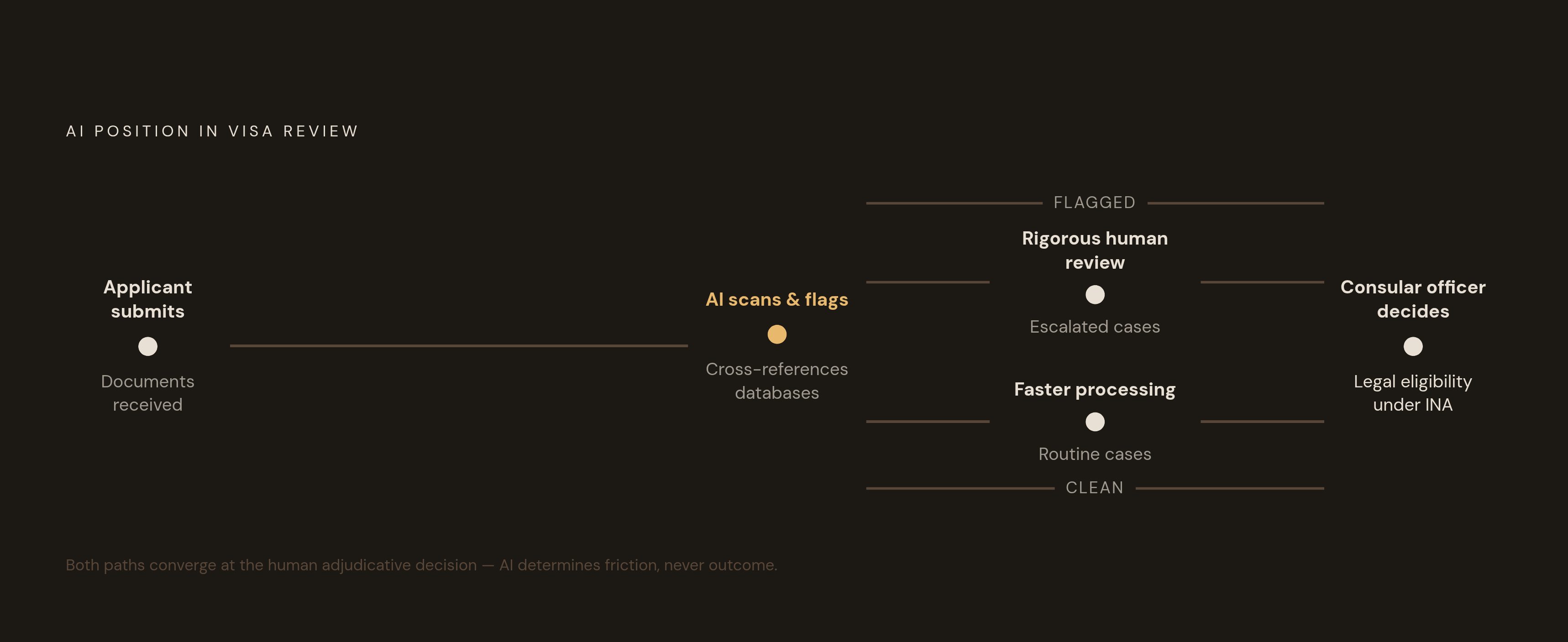
AI is now embedded in high-volume visa application review as upstream workflow infrastructure, operating before a consular officer ever reaches a case. It scans documents, detects inconsistencies, and flags cases for human escalation. It does not approve or deny visas, and no public evidence currently exists that it does.
The Department of State has said publicly that it plans to deploy agentic AI, embed AI tools into existing consular systems, and layer automated capabilities on top of legacy platforms. State Department CIO Kelly Fletcher has stated plainly, "We're going to roll out agentic AI," and described plans to "slap AI agents on top of older systems." Tools already in operation include internal research and drafting assistants, AI-powered document summarization, international news aggregation tools, and an experimental post-adjudication quality review system called ARRE. These are real systems running in production, not prototypes awaiting permission.
Consular officers retain legal adjudicative authority under the Immigration and Nationality Act. The State Department's own Foreign Affairs Manual states that visa eligibility determination is the officer's statutory responsibility and may not be delegated. What AI does instead is operate upstream of that decision, filtering information, flagging anomalies, and shaping the context in which human officers exercise judgment. The distinction between decision support and decision influence is consequential for every applicant.
What the upstream filter actually does: document scanning, inconsistency detection, and case flagging
The core operational task is large-scale cross-referencing. AI simultaneously analyzes dates, addresses, employment histories, and signatures across all forms submitted over time, generating automatic alerts when current information does not match prior statements. A human reviewer reads a single application. The AI is comparing a current submission against every prior filing, database record, and social media footprint at once. That is a qualitatively different analytical capability, not simply faster form-checking.
When a mismatch is detected, the software generates an automatic alert that refers the case for much more rigorous human review. The AI flags. A human evaluates. The alert does not itself change the outcome. It decides which cases get additional scrutiny and which move through without friction. USCIS has described AI as acting as the first line of defense for security and consistency, which captures the operational reality precisely: the machine sorts, and the officer decides.
The cross-referencing extends beyond submitted forms. AI tools can draw on databases from other federal agencies, public records, and pattern analysis across evidence. Enhanced vetting now includes review of social media, online activity, and information from other federal agency databases, including the State Department's Consular Consolidated Database. The system can identify whether letters of support or lease agreements use templates identical to those in other cases under investigation, a pattern that would be invisible to any single human reviewer. For applicants, the practical result is that automated screening may flag data inconsistencies, travel anomalies, and document irregularities without ever telling you or your attorney. The process itself remains opaque.
The strongest objection to calling this meaningful AI is that it reduces to automated form-checking. The counterargument is scale and pattern recognition, and the difference matters. Comparing a current submission against every prior filing, database record, and social media footprint at once is not an incremental improvement over human review. It is a different kind of analytical operation, one that no consular team could perform manually at the volume the visa system processes.
The governance layer: why High-Impact AI classification shapes every design decision
An OMB memorandum presumes AI used in immigration contexts to be High-Impact AI, subject to agency determination. That classification directly determines the system's design: meaningful human oversight is mandatory, timely human review must be possible, and documented accountability procedures are required. Agencies can rebut the presumption, and one immigration agency has classified fourteen such systems as presumed high-impact but determined not high-impact. But where the classification holds, it functions as a design constraint, not a preference.
The Department of State's Foreign Affairs Manual reinforces these requirements. It mandates designated ownership and compliance review for AI systems that affect rights, and requires each bureau or office owning an AI use case to maintain a documented governance structure with an associated owner. The practical implication is direct: if AI shapes a visa outcome in any way, federal policy requires that a human being remain accountable for that outcome. This is not aspirational policy. It is the procedural foothold that makes human-in-the-loop design non-optional rather than a feature choice.
The distinction between decision support and decision influence is where the governance framework does its real work. AI filtering information and surfacing anomalies is shaping the context in which human officers exercise judgment, even when the officer retains formal authority. The compliance framework functions as a de facto production-readiness checklist, and it creates procedural avenues for applicants that would otherwise not exist. If you receive a denial that looks inconsistent with the record you submitted, you can request reconsideration, escalate through supervisory consular channels, or pursue FOIA requests for copies of your own submitted documents, though internal screening procedures are generally exempt from disclosure under INA 222(f). The human accountability requirement is what creates those avenues.
Where legitimate applicants gain: how upstream AI accelerates processing for clean, consistent files
The same AI infrastructure that flags anomalies also speeds processing for applicants whose records are clean, consistent, and thoroughly documented, because it automates the administrative sorting work that used to consume officer time. AI enables documents to be sorted and organized efficiently, helping speed the issuance of work permits and travel authorizations for humanitarian and family-based visa categories. This is not a redistribution of scrutiny from one group to another. It is a reallocation of human attention away from routine sorting and toward substantive evaluation.
The mechanism is straightforward. If your application is professionally structured and internally consistent, it moves through automated screening without generating flags, so it reaches a human officer faster and without the extra scrutiny that flagged cases carry. By handling routine administrative tasks, AI frees officers to evaluate the actual merits of complex applications, a genuine allocation improvement rather than a marketing claim. The officer's time is the scarce resource, and the system directs it where it produces the most value.
On the applicant side, multi-agent workflows for application preparation have emerged as a structural response to this environment. Specialized agents covering eligibility checks, document verification, compliance analysis, gap identification, and action roadmaps collaborate to produce a submission that is ready for both human and automated review. The logic mirrors the government-side system itself: narrow agents handling defined functions, sequenced so their outputs converge on a single, review-ready file. The same architectural pattern operates on both sides of the review process.
The architectural pattern behind high-volume document review: why narrow, sequenced agents outperform broad ones
The architecture that works in high-volume visa review, narrow agents scoped to a single well-defined task, sequenced so outputs feed into human escalation paths, is the same pattern that succeeds across regulated document-processing verticals. Successful deployments start with agents scoped to a single, well-defined task with measurable outputs: a document classifier, a data enrichment pipeline, a routing agent. Expansion comes after the narrow task proves reliable, not before.
The reason broad agents fail is specific and reproducible. Agents designed to handle open-ended tasks suffer from compounding quality variance and untestable edge cases. Every additional degree of freedom multiplies the number of states the system can enter, and at scale the failure modes become impossible to enumerate in advance. A narrow agent has a measurable output and a bounded input space, which makes its performance testable against defined criteria. That testability is what separates a system that can be operated in production from one that can only be demonstrated.
The multi-agent collaboration model seen in applicant-side visa tools, where specialized agents for eligibility, document verification, compliance, and gap identification each handle a defined function, mirrors the architecture that production-grade enterprise systems use in legal document review, healthcare prior authorization, and financial compliance workflows. Legal is the structural analogue worth naming directly. The work being automated is document-heavy, rule-demonstrable, and high-volume, the same three criteria that make visa review suitable for agent deployment. The production-readiness standard that applies here is technical and precise: real users, accepted outputs, a responsible owner, explicit permissions, a support process, and a recovery path. The visa review context satisfies all of these by regulatory requirement, which is part of why it has moved further than many enterprise deployments.
What the production gap between pilot and deployed system reveals about enterprise AI readiness
The reason government visa AI has reached production while most enterprise AI pilots have not is organizational, not technical. The visa review context forces the conditions that enterprise deployments typically lack: defined success criteria, mandatory human oversight, documented accountability, and clear ownership. These are not features that enterprise teams discover through iteration. They are constraints imposed by the OMB memorandum, which requires documented accountability procedures, designated ownership, and timely human review. The compliance framework functions as a de facto production-readiness checklist, and it is the checklist that makes production operation possible.
Use cases most suitable for production deployment share three characteristics that visa review satisfies. They are high volume, rule-demonstrable, meaning a large majority of cases follow defined patterns, and measurable, with clear before-and-after metrics that show the system's effect on throughput or quality. The ROI case for document-processing agents is strongest in verticals that share this profile: high transaction volume, rule-based patterns, measurable throughput. That is why financial services shows the highest production deployment rate among enterprise verticals. The pattern holds wherever the work is document-heavy and the rules are demonstrable.
The implication for any organization evaluating a similar deployment is that the governance and accountability structures that feel like bureaucratic overhead are actually the conditions that make production-scale operation possible. They are not obstacles to it. They are the difference between a pilot that demonstrates capability and a system that operates reliably under real load, with real users, where failure has consequences that someone must answer for. The architectural and governance lessons from visa AI are portable to any high-volume, regulated document workflow, and they suggest that the organizations most ready to deploy agents at scale are those that already know who owns the system and what happens when it fails.
Methodology & sources
- How AI Is Changing U.S. Visa Adjudication in 2026 - Ahluwalia Law
Provided details on the State Department CIO's statements about agentic AI rollout, the ARRE post-adjudication quality review system, and the classification of fourteen AI systems as presumed high-impact.
- Artificial Intelligence and USCIS: How Will Technology Affect the Review of Your Application in 2026? - James Immigration Law
Provided information on USCIS's use of AI as a first line of defense for security and consistency, enhanced vetting through social media and federal database cross-referencing, and AI's role in speeding processing for humanitarian and family-based visa categories.