AI Deployment Readiness Audit for Insurance Defense Operations
A readiness audit tests whether defense AI can survive scrutiny.

An AI deployment readiness audit for insurance defense operations tests whether a system can stand up to regulatory examination, own a real workflow, and produce results that can be measured. It is not a compliance checkbox. Most deployment failures start with how the work around the model is set up, so readiness depends on having evidence, ownership, and controls in place before production.
Why insurance defense AI faces a different kind of deployment failure
When the plaintiff bar’s AI produces documented outputs but the defense operation cannot produce a traceable decision log, the asymmetry extends beyond productivity. The defense faces exposure in discovery and regulatory examination simultaneously. A useful answer is not enough on its own. Insurance defense spans legal, healthcare, and automotive claims, and each field has its own rules for documentation and liability. A deployment must support those obligations as well as the task it automates.
Aviva put AI to work across claims, which cut the time spent on liability assessment for complex cases, improved routing accuracy, and led to fewer complaints. Those results required governance capable of supporting the work. Allianz’s Project Nemo illustrates the accountability requirement more directly. Its claims resolution time dropped dramatically, while a human professional approves every payout. The structural gap a readiness audit closes is the distance between a system that performs a task and an operation that can account for its decisions.
The regulatory forcing functions that made audit readiness non-negotiable in 2026
The NAIC Model Bulletin on AI has been adopted by a substantial share of states, and a number are piloting the AI Systems Evaluation Tool during market conduct examinations. The tool’s four exhibits ask for an AI inventory, governance controls, high-risk model documentation, and a data assessment. The model documentation includes testing, validation, and human-oversight detail, while the data assessment covers sourcing, quality, and lineage.
The Insurance Services Office’s commercial general liability AI exclusion, CG 40 47, effective January 2026, removes generative AI-caused bodily injury and property damage from CGL coverage where the exclusion applies. California’s AB 316, effective January 1, 2026, bars defendants that developed, modified, or used an AI system from asserting that its autonomous conduct caused the harm.
Together, these developments turn governance from a statement of intent into a demand for evidence across jurisdictions, examinations, liability disputes, and coverage decisions. Insurers increasingly ask for the same governance evidence needed to defend against a product liability claim before they set a price for AI risk. A carrier needs more than proof that an AI policy exists. It needs records showing what its systems did, which controls applied, and who remained accountable.
Why most deployments cannot produce what regulators are now asking for
Most insurance AI deployments were built to produce business value, leaving a gap in examinable records. Timing explains much of the gap. Enterprises put their first production systems into service before regulatory frameworks were final, keeping logs in formats that engineers could work with but that auditors might not be able to use. Model versions were tracked inconsistently, and input features were preserved inconsistently, creating documentation debt that puts executives at risk when an examination calls for evidence that the operation had no routine way to keep.
The traditional response is manual assembly across claims systems, IT logs, vendor portals, and email threads, without assurance that the resulting record is complete or consistent. A reviewer may have an output without the corresponding model version, or an approval without the inputs that informed it. Documentation must explain a particular decision under the conditions that existed when it was made.
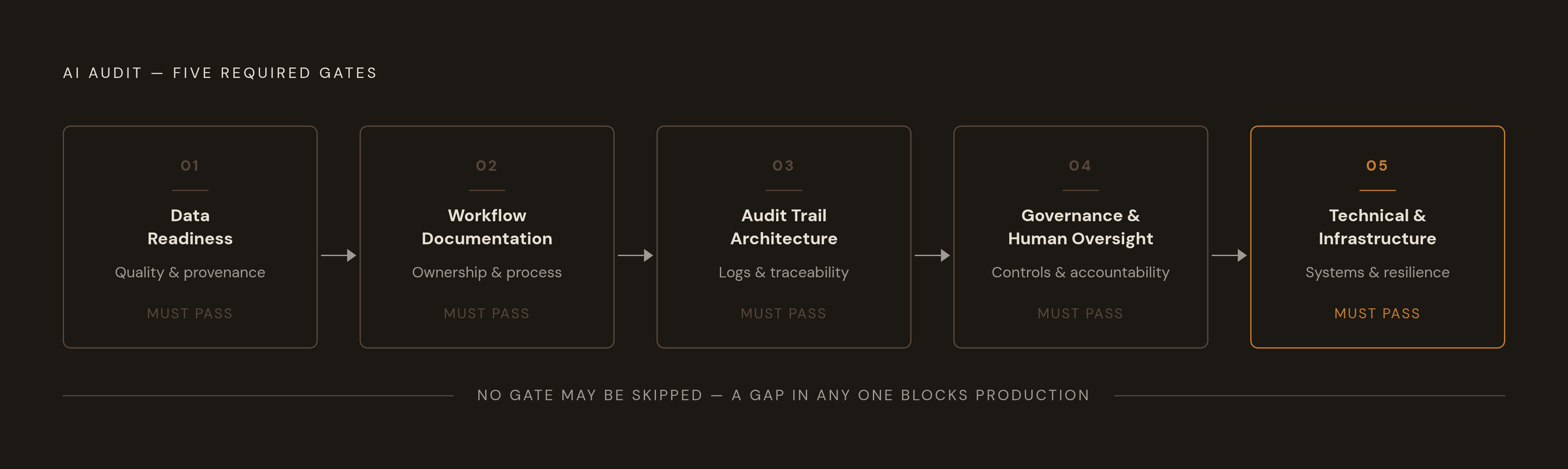
Pilot success can conceal this weakness because a demonstration tests a narrower proposition than production readiness. Only a small share of organizations that deploy AI agents have mature governance models, while many have gaps in their audit trails, rollback mechanisms, or escalation paths. A thorough audit therefore checks the conditions around the model across five dimensions, so that model performance alone does not stand in for how the whole operation works.
What a rigorous deployment readiness audit actually examines across five dimensions
Data readiness begins with whether policy, claims, actuarial, and third-party data can be queried through a single governed layer. A need to make a manual extract request is a warning sign. If the actuarial team needs one to access claims data, the foundation for production AI in underwriting or pricing is missing. The audit establishes whether policy and claims data have a single source of truth, how long a clean training dataset takes to produce, and whether responsibility for data quality is documented. Fragmented infrastructure can undermine even a superior model configuration.
Permission is a separate test from availability. Data lawfully held for one purpose is not automatically lawful to send to a third-party model, particularly where HIPAA business associate agreements or vendor terms restrict onward use. The audit must distinguish what the organization possesses from what it may use in the proposed workflow.
Workflow documentation and ownership examines whether claims intake, underwriting review, and FNOL triage are documented to the step level, with explicit decision rules and exception paths. Automation otherwise accelerates inconsistency. The audit checks whether claims intake yields the same structured output no matter who handles it, whether there is a written framework for underwriting criteria, and whether baseline cycle times are on record. Those records define the process the system is expected to own. Operational ownership also requires replacing a general reference to “the AI team” with a named person who is on call when the feature breaks.
Audit trail architecture examines whether the decision record preserves timestamps, the model version, and inputs and outputs at each stage. The record must also retain the policy language or retrieved knowledge used, the validation layers that approved or declined intermediate states, participating human reviewers, and the configuration in effect at the time. Later configuration changes cannot rewrite the historical record. Versioning is therefore part of the evidence architecture. Monitoring that cannot be activated retrospectively must exist before launch, because missing observations cannot be supplied by a later policy change.
Governance and human oversight examines written rules for AI use, a person accountable for enforcing them, and a record of governance decisions. Unread policies do not establish an operating control. The audit also tests the literal sequence of steps needed to disable the feature for all users in under five minutes. An untested rollback plan does not pass that test. Human oversight must be equally explicit about which decisions require professional approval, making accountability part of the workflow.
Technical and infrastructure readiness checks whether core systems are API-accessible and whether model outputs can return to the workflows that use them without someone moving them by hand. Legacy core system lock-in is a primary obstacle. The security review looks at identity and access management, how secrets are handled, how inputs and outputs are logged, and how vendors and subprocessors are reviewed. It also examines a tested response path for prompt injection, data leakage through model output, and unauthorized action by an autonomous agent. An organization unable to identify who can access a dataset today cannot assume that access will become clearer when an agent queries it for many employees.
Each dimension must meet a minimum standard before the system is ready for production deployment. Strength elsewhere cannot cancel a missing control. Accessible data does not compensate for absent permissions, and a complete log does not substitute for an accountable workflow owner. Passing all five dimensions is the basis for moving quickly with confidence.
How to measure whether the AI is working once it goes live
The audit establishes measurement before deployment so that performance remains accountable after launch. Without continuous evaluation, a system can drift out of compliance and lose business value at the same time. Measurement belongs inside governance. The same operational structure that assigns ownership and preserves decisions must support an assessment of whether the system continues to do useful work.
Five measures connect AI spending to insurance defense performance, namely loss ratio on AI-screened segments, hit ratio on submissions, claim leakage rate, expense ratio by function, and claims cycle time together with ALAE, or allocated loss adjustment expense per claim. These measures connect automation to operating economics. Their role is different from demonstrating that a model can generate an acceptable answer. The audit’s measurement baselines give the operation a reference against which to assess results.
Within claims operations, handling time, routing accuracy, complaint rate, and human review touchpoints provide a closer view of workflow performance. Aviva’s reduction in complex-case liability assessment time by weeks illustrates the kind of operational outcome that can be tracked. Underwriting requires its own measures, including submission intake volume and quote turnaround time. Leading carriers have compressed multi-day underwriting timelines to minutes in production.
Continuous evaluation on production traffic checks whether quality remains good enough to support those outcomes. Launch testing alone cannot expose later regressions. If quality is measured only at deployment, failures can accumulate until a customer or regulator surfaces them. An AI system that owns a workflow and delivers measurable results is the only one worth defending to a regulator or a board.
What a deployment readiness audit looks like as an operational engagement
Purple Shield Security’s assessment framework describes a scoped engagement at mid-market scale as typically running two to four weeks and ending in a prioritized roadmap. The deliverable is remediation. It identifies the gaps, the steps required to close them, and the people responsible for doing so. Assessment before capital commitment places those findings where they can influence the deployment decision. Finding the same gaps after a failure in production leaves the operation with fewer choices and exposure it must deal with now.
The engagement covers all five dimensions, because weakness in any one can block deployment or create regulatory exposure in an existing system. For systems already live, the work becomes a retroactive assessment of their decision records, controls, ownership, and infrastructure. Remediation follows the size of the gap and the urgency of the regulatory timeline. Not every deficiency has equal operational consequence. Retrofitting auditability after a regulatory finding can cost multiples of the original deployment, while building it into the system from the start is comparatively inexpensive.
Eigenomic, an enterprise AI agent builder that also offers AI Operations Audits, is one option among firms applying this readiness-before-launch approach through a structured diagnostic anchored to the same five dimensions. Its engagement connects regulatory examination, end-to-end workflow ownership, and measurable ROI to a production roadmap with remediation steps, named owners, and measurement baselines.
The resulting roadmap establishes what must be true before the system assumes production responsibility, and what will be measured afterward. Unresolved gaps remain explicit in the launch decision. The audit is the gate that makes production deployment defensible from day one.