Litigation Budget Forecasting With AI in Insurance Defense
How early AI scoring at first notice of loss can control defense costs.

Litigation budget forecasting with AI in insurance defense begins at first notice of loss. Accurate forecasts depend on spotting severity, likely attorney involvement, and venue risk before they drive up defense costs. Early triage is the foundation of that workflow, while bill review and reserve modeling extend its value only when claims reach the right handling path.
Why attorney involvement transforms a claim's cost trajectory before litigation begins
Sedgwick and Milliman data show that commercial auto claims involving an attorney cost dramatically more to resolve than those without representation. Once litigation counsel engages, discovery, depositions, and motion practice are already priced into the claim’s trajectory. A reserve adjustment made at that point may recognize the exposure more accurately, but it cannot recover the earlier opportunity to change how the file was handled.
Traditional triage assigns claims to queues based on reported facts, yet those facts do not by themselves distinguish which files contain the behavioral and contextual signals associated with future attorney involvement. Two claims that appear similar at intake can require different handling because their likelihood of becoming contested is different. The insurer has less room to act if it sees that difference only after counsel appears.
This makes attorney-involvement prediction the most valuable early signal in the forecasting workflow. It changes the question from how much a litigated file now requires to which files are likely to enter a more expensive handling path. Accounting is still needed, but it measures commitments already made. Forecasting can do more when it helps guide decisions on staffing, reserves, and resolution before those commitments are made.
What AI-driven claim scoring at first notice of loss actually does
AI-driven scoring reads signals about the claim, the venue, and behavior together at intake. Severity probability estimates whether a claim is likely to exceed a reserve threshold, using loss type, injury description, and historical analogues. Attorney-involvement probability uses signals that include prior representation history, how complex the claim is, and jurisdiction to estimate whether counsel will enter.
Venue risk adds a separate dimension because jurisdiction can change the exposure associated with the same underlying loss. Signals include courts that favor plaintiffs, how judges tend to rule on specific motion types, and what is usual for local damages. These are not interchangeable with injury severity. Sedgwick’s proprietary AI-powered algorithm and attorney scorecards compare litigation outcomes by severity of injury, jurisdiction, and head-to-head matchups of defense and plaintiff counsel. That illustrates how contextual comparisons can inform assessment without reducing it to the reported injury alone.
The scoring output functions as a routing decision rather than merely a recommendation attached to a file. It changes who is assigned to the file, the reserve level, which panel counsel is chosen, and settlement authority. Intake data is sparse, so the objective is not certainty. The value lies in probability-weighted routing that identifies the top severity tier early enough for intervention. A precise reserve set after attorney engagement answers a different, later question. Early scoring is useful when, even with its uncertainty, it leads to a better handling decision than the usual queue assignment.
How venue intelligence and plaintiff-side AI are raising the floor on what budgets must anticipate
Plaintiff-side AI and third-party litigation funding have raised the cost floor that litigation budgets must plan for. Plaintiffs now rely less on slower ways of preparing that use less data, while funding changes the resources they have to pursue a claim. The defense forecast must account for that capacity. Historical loss patterns remain useful, but they are not a complete description of the resources an opposing party may bring to a particular dispute.
AI-enabled pro se filings create a distinct source of defense cost. Generative AI lowers the barrier to filing suit, increasing the volume of claims requiring a response even when their legal merit is weak. A weak filing still requires defense work. Testing its allegations, narrowing its scope, or obtaining its defeat can consume resources regardless of the eventual outcome. This mechanism differs from better-resourced plaintiff counsel because it increases the response burden without necessarily increasing the strength of the underlying claim.
Courts are also imposing requirements on AI-generated work. Minchin v. Ascend Wellness Holdings, Inc. required “mandatory certification that the AI work product was diligently reviewed by a human being.” That requirement addresses the reliability of the filing process, but it does not eliminate the work needed to respond to a filed claim. To forecast costs, the venue assessment must account for how many claims are filed and what the plaintiff side can do, alongside how judges have ruled in the past. Early-stage scoring can synthesize those inputs at a scale traditional adjuster triage cannot, giving the intake decision a broader basis than past damages outcomes alone.
What automated legal bill review and reserve accuracy gains look like in practice
Once claims are routed, automated legal bill review addresses high-volume work that otherwise consumes adjuster attention. AI audits invoice lines against agreed billing guidelines, flags duplicate time entries and block billing violations, and surfaces partner rate substitution for paralegal-level work. Compliant invoices do not require manual review. Automated auditing recovers 12 to 18% of gross legal spend, leaving adjusters more time for decisions that require judgment.
Reserve modeling serves a different downstream purpose. Litigation trigger models and judicial trend analysis refine reserves as the case progresses, using the same venue intelligence that informed the initial score. Early routing and later reserve updates thus share an analytical foundation. Their functions remain distinct, however, because recognizing a developing exposure does not undo an unsuitable initial assignment. A misrouted file can generate waste that an invoice audit cannot correct.
State Farm provides a named example of production deployment at carrier scale. State Farm reported 41 agentic solutions in production in Q3 2026, with early uses that included document management, workflow automation, and support for life underwriting. It reported improvements in workflow speed and efficiency soon after agent launch. Those figures establish production scale, a distinction that matters when setting benchmarks for carrier-specific litigation bill recovery or reserve accuracy. AI already in use shows that workflows can move into production, but the case for forecasting still rests on measuring how well intake routing, reserve updates, and spend controls work together on the same claims.
The governance and privilege requirements that determine whether early-stage AI scoring holds up under scrutiny
Technical accuracy alone does not make an early score operationally trustworthy. Insurance defense systems must protect privileged information and make automated decisions open to examination. Using public LLM APIs can expose attorney-client privilege when claim or case data is used for model training. Private, isolated cloud-hosted agents are therefore part of the shift toward confidential legal AI infrastructure in 2026. The architecture is a legal condition of deployment.
The Legal AI Agentic Deployment Readiness Report 2026 says litigation departments have the lowest AI production rate among legal functions. Practitioners cite court rules, sanctions risk, and malpractice exposure as reasons for caution. The report also finds that only a small fraction of organizations met all four operational readiness criteria. Those criteria are a written agentic authorization policy, mapped rollback protocols for each production workflow, tested stale-context failure scenarios, and differentiated agentic liability terms in vendor contracts. A pilot that works still leaves those safeguards to be put in place.
For insurers, the consequence is direct. Scoring models must be auditable, outputs must be logged, and human review points must be designed into the workflow so that decisions can withstand litigation and regulatory review. The bad-faith concern surrounding automated health insurance decisions also has a broader application. An insurer using automated decision tools needs a defensible basis for how those tools influence claim handling.
CSIS’s September 2026 analysis identifies information asymmetry as the core failure in the insurability of AI risk. Carriers cannot see which models insureds use or how those models are governed. The same problem runs in reverse when an insurer’s own automated processes are undocumented. Internal governance records help close that gap by making the system and its controls visible to scrutiny.
How panel counsel requirements are turning AI readiness into a competitive condition for defense firms
Major carriers are using panel reviews to apply their own AI requirements to outside counsel. Defense firms must demonstrate production-ready capabilities, including document review and case assessment. Legal quality alone no longer secures the assignment. As carriers direct work toward more efficient firms, operational readiness becomes a condition of remaining competitive within the panel.
Counsel who use structured document review and case assessment can send better, structured case data back to the carrier’s models. The feedback loop depends on usable information. Counsel performance data and case developments can improve claim-scoring accuracy only to the extent that the information panel firms produce supports that analysis.
Smaller regional firms do not necessarily need to match the investment of larger panels. A firm running structured document review and case assessment on live files meets an operational standard. This keeps the panel requirement focused on the forecasting workflow. The relevant capability is the firm’s ability to perform the work and return useful case information.
How to structure an AI forecasting deployment that starts at first notice and scales across the defense workflow
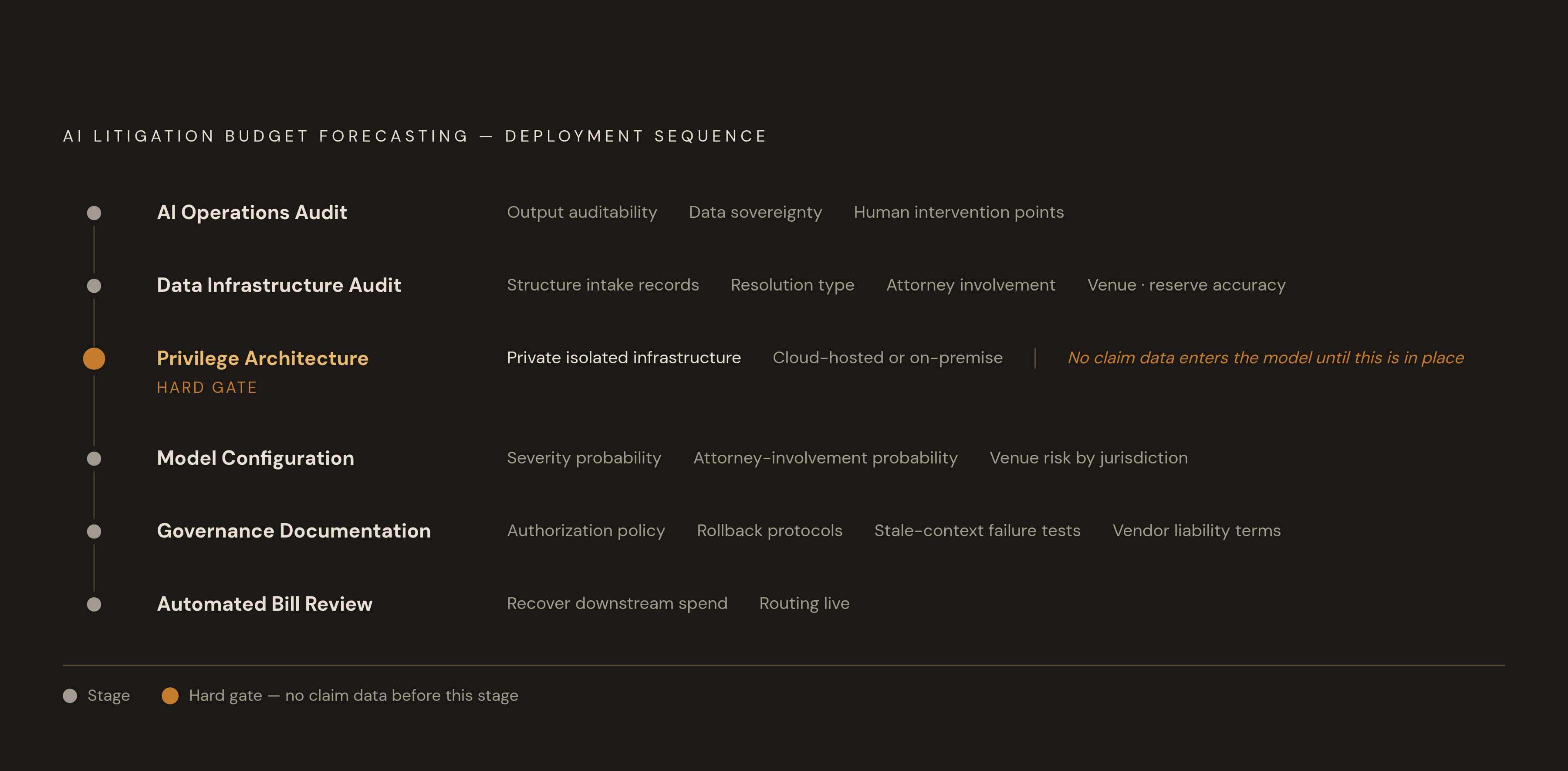
The deployment sequence should begin with an AI Operations Audit that identifies the gaps requiring remediation before live scoring. Grant Thornton’s 2026 governance audit survey found that a large majority of senior business leaders lacked full confidence that their organization could pass an independent AI governance audit within a short timeframe. Self-assessed readiness is not sufficient evidence. The diagnostic should establish whether outputs are deterministic enough to audit, data sovereignty is maintained, and human intervention points are built into the proposed workflow.
The first implementation step is a data infrastructure audit. Intake records must have enough structure to feed the scoring model, and data on past outcomes must be clean and easy to access. The outcome data needed includes resolution type, attorney involvement, venue, and reserve accuracy. Privilege architecture must be in place next, before claim or case data goes into the model. Private, isolated cloud-hosted or on-premise infrastructure addresses the exposure created by public API deployments and establishes the boundary within which configuration can proceed.
The model is then configured to set severity probability, attorney-involvement probability, and venue risk, with calibration by jurisdiction and training on past claim outcomes. The scores need explicit operational consequences. Routing rules should define which tiers go to senior adjusters, which files move immediately to panel counsel, and which follow streamlined handling. Without those rules, a score remains an assessment rather than a functioning part of defense cost control.
Governance documentation must be completed before the workflow goes live. The authorization policy, rollback protocols, and tested stale-context failure scenarios establish how the system may operate and how failures will be handled. Vendor liability terms must also cover how agents are used. Once routing is live, automated legal bill review can be integrated to recover spend downstream of the initial handling decision. This sequence gives billing controls a defined role without treating them as a substitute for sound triage.
Production readiness is the threshold for launch. A live, auditable system that routes files correctly provides more forecasting value than a more sophisticated model confined to testing. Its return should then be measured through reserve accuracy improvement and defense spend reduction over a defined claims cohort. That measurement returns the deployment to the underlying economic problem.