Automated Status Reporting for Insurance Defense Panel Counsel
Automation only helps when it chases attorney inputs and confirms delivery.
Automated status reporting for insurance defense panel counsel is an operational workflow. It reduces relationship risk and hidden coordination costs only when deadline monitoring, attorney data collection, escalation, carrier-format output, and confirmed delivery form one accountable process. Automating the draft while leaving people to chase inputs or prove receipt merely relocates the bottleneck.
Why carrier reporting is a relationship liability, not just an administrative task
A missed or malformed status report puts a carrier relationship at risk. Insurance defense is a cost-driven practice in which operational reliability influences panel retention as well as legal outcomes. Carriers treat reporting performance as a proxy for file management quality, so a late or incomplete update can undermine confidence in the underlying legal work. The report becomes evidence of how the firm operates.
That risk grows as carriers use AI to oversee counsel. Automated review makes reporting quality visible across firms rather than dependent on an individual adjuster’s capacity to scrutinize each submission. A thin report is therefore more than an isolated administrative defect. It can become part of a comparative record of the firm’s reliability.
What breaks in the manual reporting cycle and where the hidden costs accumulate
Manual reporting tends to break down at three points: tracking deadlines, gathering data, and meeting format requirements. When staff manage calendars by hand, a missed entry can leave a report untracked on any case in the active docket. Even when the deadline is recorded, the report depends on information gathered from the responsible attorney, case management notes, and billing records. A calendar entry cannot secure those inputs.
Email-and-phone collection provides no enforcement mechanism when an attorney is in trial or delayed. If an informal request goes unanswered, the paralegal must either assemble an incomplete report or absorb the work of escalation. Neither outcome necessarily appears as a reporting failure in the firm’s metrics.
Differences in format add work because each carrier needs its fields laid out differently. Manually reshaping the same information adds labor as carrier relationships multiply, independently of file volume. These failures concentrate costs in paralegal time, particularly when a senior paralegal spends a meaningful share of the role coordinating reports, reducing time available for supporting substantive legal work. The expense follows from the broken process.
What a complete automated reporting workflow actually contains
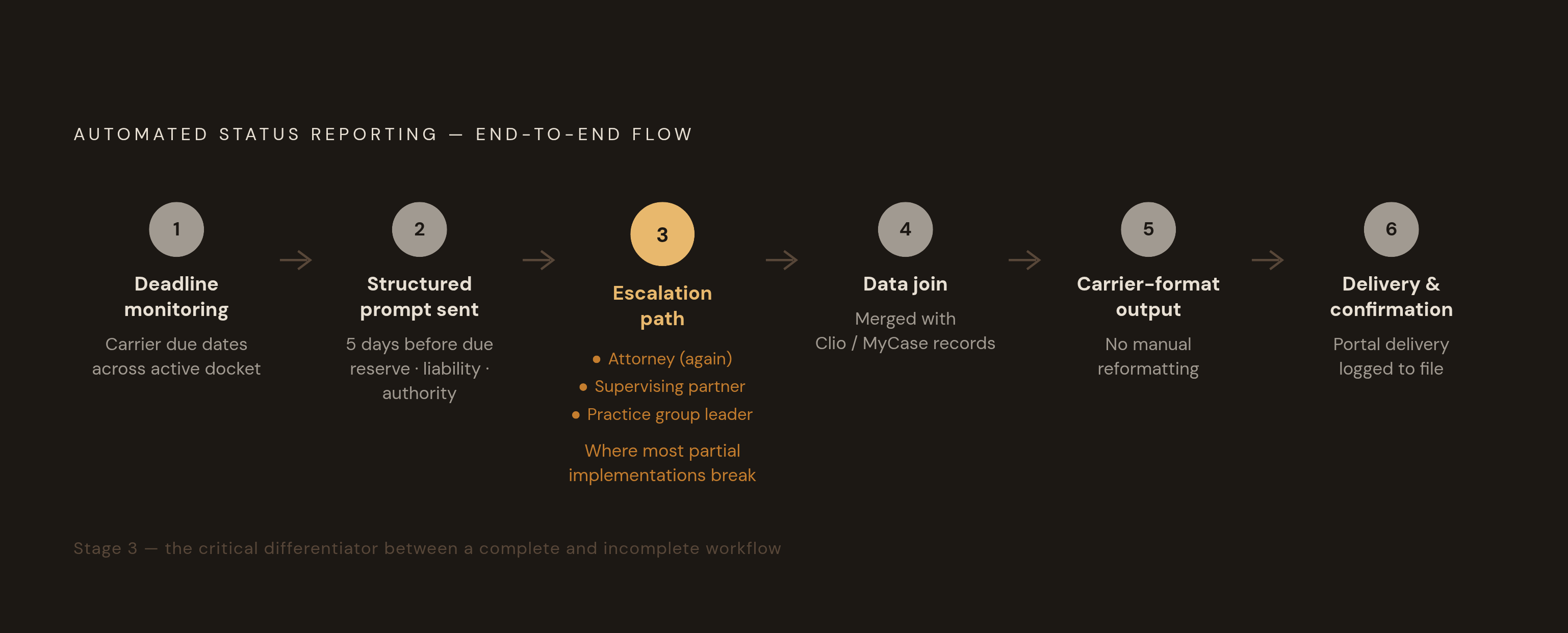
A complete workflow starts by tracking what each carrier requires across the full active docket. At a fixed interval before the report is due, typically five days, the system sends the responsible attorney a structured prompt containing the carrier’s required fields. Those fields can include a reserve recommendation, liability assessment, and settlement authority request. Structured input prevents the downstream reconstruction that open-ended narrative responses require.
Collection then needs an enforceable response path to completion. When the attorney does not respond within a defined window, the system escalates first to the attorney again, then to the supervising partner, and then to the practice group leader. The handoff must not depend on a paralegal noticing silence. Once the answers arrive, the system joins them with practice management records and puts the report in the format the carrier requires, so no one has to reformat it by hand.
The source of those records is equally important. Output should draw from Clio, MyCase, or the equivalent system of record rather than a parallel store that can diverge from billing and matter management data. The workflow then delivers the report to the carrier portal or contact and logs delivery confirmation back to the file. That final record provides proof of receipt and closes the chain from the original deadline trigger to confirmed delivery.
Why the attorney data-collection stage is where most partial implementations break
Getting data from the attorney is the handoff most likely to fail because it relies on someone who may have more pressing work to send input on time. Practice management systems provide the case record, but that record does not itself supply carrier-specific prompts and escalation. The missing component is reporting orchestration. Without it, the firm has organized information but no reliable mechanism for obtaining the attorney’s current assessment.
An email or task-management workaround can reproduce the same weakness. The prompt goes out automatically, but a person still watches for the reply. When trial, depositions, or a filing crunch consumes the attorney’s attention, a 48-hour response window can pass without automated consequence. The paralegal resumes chasing the same missing input. A purpose-built orchestration layer instead reads the case record, sends structured requests through the attorney’s preferred channel, and tracks response status and escalation in the workflow engine.
Connected collection also requires continuity in the case analysis. Turbo Law illustrates this through a shared matter record supporting intake evaluation, chronology, discovery, motions, and reporting. If a new deposition changes the causation analysis, a latest-document summary alone does not retain earlier intake contradictions or the defense theory. The partner must rebuild that context before updating the carrier. Drawing from the developing record avoids treating each report as a fresh reconstruction, which becomes especially important when the recipient compares the report with the underlying evidence.
What carriers are doing with the reports they receive and why format and content completeness now matter more
CaseGlide’s Case Clerk AI reads defense counsel status reports and extracts what they actually say. The platform evaluates firms and attorneys on reporting quality, responsiveness, cycle time, and results, and syncs the updated structured case file to the carrier’s claims system. Reporting is no longer solely a document-reading exercise. Its contents can become structured inputs to counsel evaluation and claims handling.
Missing fields therefore have consequences beyond an adjuster’s impression of the prose. When a report leaves out a reserve recommendation, liability assessment, or next action, it is missing information that automated review can look for. Structured prompts that ask attorneys for those details gather the needed information before drafting starts. An open narrative email offers no equivalent assurance. Format compliance makes the required content identifiable, while complete collection supplies the substance.
Tools that compare counsel’s account with the claim record can expose discrepancies between the stated exposure and the underlying evidence. A report built from the same current matter record that supports chronology and discovery is better positioned to remain consistent with that evidence. Shared source data reduces the separation between the file the attorney analyzes and the account the carrier receives.
The legal and regulatory constraints that the workflow must be built around
Reporting automation must meet professional responsibility requirements and a growing set of state rules on AI. These constraints call for documentation from the outset. The Lokken discovery order in March 2026 illustrates how AI use in claims handling may open discovery into implementation, supervision, and actual use. A defensible workflow therefore needs an audit log of automated actions and human approvals, showing that AI supports required human review.
Warner v. Gilbarco, decided in a federal district court in 2026, held that a pro se plaintiff’s AI-assisted ChatGPT interactions that contained internal mental impressions kept their work-product protection. Carrier-facing reports are shared communications outside the scope of that holding on internal analysis. The distinction reinforces the need to document how internal analytical work, attorney review, and external delivery are handled without treating AI use as either an automatic waiver or an automatic shield.
Proposed Federal Rule of Evidence 707 is not law. The Advisory Committee on Evidence Rules declined to recommend action in May 2026 and directed further study to a Fall 2026 mini-conference associated with its October 15, 2026 meeting. The draft committee note describes five reliability considerations, including representative training data, validation under similar conditions, records and reproducibility or auditability, independent testing, and sufficient information for the opponent about how the system works. These are proposed evidentiary considerations. They nevertheless support a practical design principle for firms building now, which is to retain testing records and an auditable process rather than postpone automation until every regulatory question is settled.
How to evaluate whether a reporting automation implementation is complete or just shifts the bottleneck
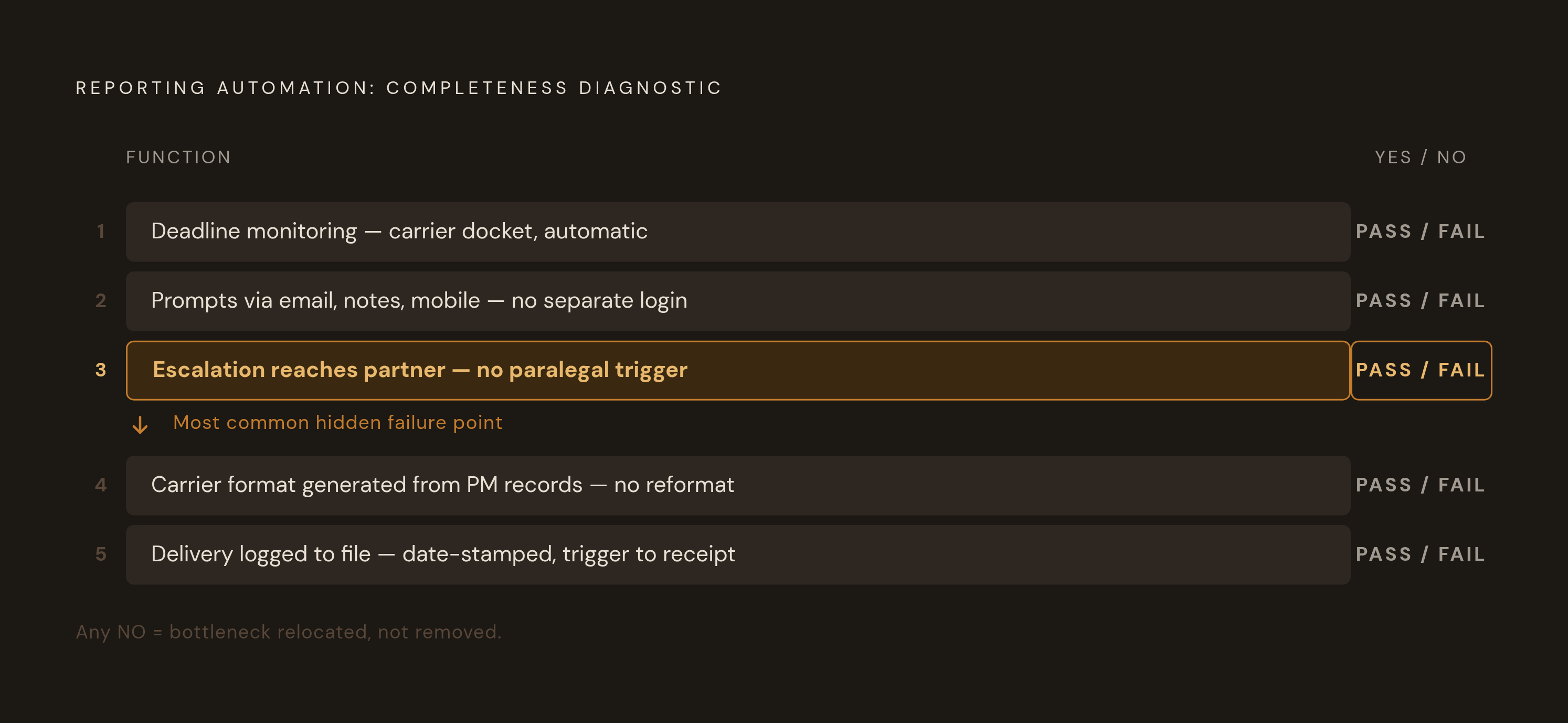
The practical diagnostic is whether paralegals still manage the reporting queue. This test distinguishes coordination from required legal review. A firm can apply five questions to its current process or a vendor proposal to locate unresolved handoffs.
Does the system automatically monitor carrier-specific deadlines across the full active docket, or does a person maintain the calendar? A manual calendar leaves the process vulnerable to one missed entry. Does it send structured prompts through channels attorneys actually use, such as email, practice management notes, or mobile, or require a separate login? A prompt in a rarely opened tool creates avoidable escalation. Repeated unnecessary alerts weaken the escalation chain’s credibility.
Does escalation reach the supervising partner automatically, without a paralegal initiating it? If not, the system has automated the request but retained human queue management. Does it generate the carrier-required format directly from practice management records, or must someone reformat the draft? That intervening step preserves both labor and error risk. These questions test whether the workflow owns the handoff rather than simply notifying someone that work remains.
Does the system log delivery confirmation back to the file record, with a date-stamped trail from trigger to receipt? Without that record, the firm lacks file-based evidence of timely delivery, even if the report arrived. The diagnostic also clarifies the architectural roles involved. Practice management holds the detailed case data, while orchestration coordinates work across carriers, handles formats, and manages exceptions. A complete setup links those roles and keeps attorney approval separate from the work of chasing reports.
What production-ready deployment looks like for a firm building this workflow from scratch
Deployment should move from offline evaluation to historical replay on closed files, then to shadow mode in which the system runs without taking action. Next, the system makes recommendations only, with attorneys approving every output before it can act on its own within limits on a defined set of files. Full production still requires continuous monitoring and rollback capability. A successful demonstration is not an adequate substitute.
Historical replay exposes weaknesses that a vendor benchmark cannot resolve for the firm. Comparing proposed outputs against reports actually filed on closed matters tests the workflow against the firm’s own records and supplies evidence of pre-deployment evaluation. Shadow mode then reveals format errors and escalation gaps while outputs remain unsent. It also gives attorneys a visible basis for trust. Both stages examine the connected process rather than the quality of a single generated document.
The workflow engine must retain deadlines, response status, escalation stage, and delivery confirmation. Every write path should also follow a maker-checker model, with the system proposing the action and an authorized human confirming where firm policy or carrier requirements require review. At delivery, the record should identify the attorney who reviewed and approved the report before it was sent.
Plans must allow time to connect the workflow to practice management, set up each carrier’s formats, test escalation, and log confirmations. A firm with two or three carrier relationships and one practice management system may be able to configure an existing orchestration platform. More carrier relationships, multiple systems, or legacy tools can require a purpose-built coordination layer. A check before the system goes into production can reveal poor data, missing links between systems, and escalation rules that clash.
Eigenomic, an end-to-end AI workflow agency, offers an AI Operations Audit before deployment and builds agents around complete operational processes, making it one option beside practice-management add-ons and in-house builds. The relevant distinction is whether the implementation owns the chain through confirmed delivery. Legawrite.AI’s platform documentation sets out a standard for legal work in production that calls for verified sources, attorney review at every stage, and a provenance record for each filing. Carrier-facing reports need that same care because they are signed legal communications as well as administrative work. Production readiness is demonstrated when testing, approval, delivery, and exception handling remain accountable after the workflow goes live.