Deadline and Calendar Management Agents for Immigration Dockets
Automated agents now calculate immigration deadlines before paralegals open notices.

Deadline and calendar management agents for immigration dockets address a workflow problem. Filing windows, hearing dates, and response deadlines need to be captured, calculated, reviewed, and kept connected to the case. The central requirement is that every date belongs to a managed workflow rather than a person’s memory, with the agent itself subject to measurable controls.
Why immigration dockets are structurally hostile to manual deadline tracking
An immigration case can involve filing windows, biometrics appointments, interview dates, RFE and NOID response deadlines, and court hearings at the same time. These are not interchangeable calendar entries. Each has a different trigger, clock, and consequence, while the firm may be handling hundreds of open cases across USCIS, the visa bulletin, and EOIR. Manual tracking therefore requires more than accurate transcription. It requires staff to recognize which event starts which clock across a dense, changing caseload.
Some clocks arrive in a notice. Others do not. An RFE response deadline runs from the notice date, and missing it can result in denial. By contrast, the one-year asylum filing window starts at the client’s last entry, without a notice prompting counsel to calculate it. Master calendar and merits hearings introduce a different exposure because a missed appearance can trigger an in absentia removal order. A calendar that captures only incoming correspondence leaves an important class of deadlines outside its reach.
The routes back are narrow as well. The 180-day exceptional-circumstances clock runs from the removal order date. Missing that window closes that avenue of relief. Counsel also faces direct malpractice exposure, and where counsel’s performance resulted in an in absentia order, a showing of prejudice is not required for the ineffective-assistance claim.
How the enforcement environment has sharpened the cost of missing a hearing date
Between May and July 2026, in absentia removal orders rose sharply, and far more non-detained people were called for master calendar hearings. Greater hearing volume multiplies the opportunities for a docket failure. ICE published a Notice of Proposed Rulemaking on May 20, 2026, proposing to sharply increase the fine for certain immigrants ordered removed in absentia.
An in absentia order also changes what can happen next. It allows ICE to enforce removal without another full hearing, potentially closing off asylum, adjustment, cancellation, and other defense claims permanently. For firms managing removal dockets, the 2026 environment increases the downstream exposure attached to a missed date and strengthens the case for controls that extend beyond internal reminders.
Why most immigration software is passive and what that means in practice
Most legacy immigration software waits for a human to open a notice and enter the date. If the notice waits unread or the response window is calculated incorrectly, synchronization reproduces the problem.
Synchronization moves an entered date between systems, while calculation derives a response window from the triggering document and the applicable case-type rules. A platform that only synchronizes dates has no way to check for a calculation error on its own. Automated calculation paired with human review provides the minimum viable backstop. Two-way synchronization then connects the event to the underlying case record so that a hearing-date change updates the file as well.
USCIS, immigration courts, and statutes set dates externally, without regard to the firm’s schedule. CaseAgent describes its 2026 agent approach as reading incoming notices, calculating response deadlines, and calendaring them before a paralegal opens the envelope. This shifts the starting point from human data entry to document intake. It does not eliminate the need to review the resulting date.
What a deadline and calendar management agent actually does inside a docket
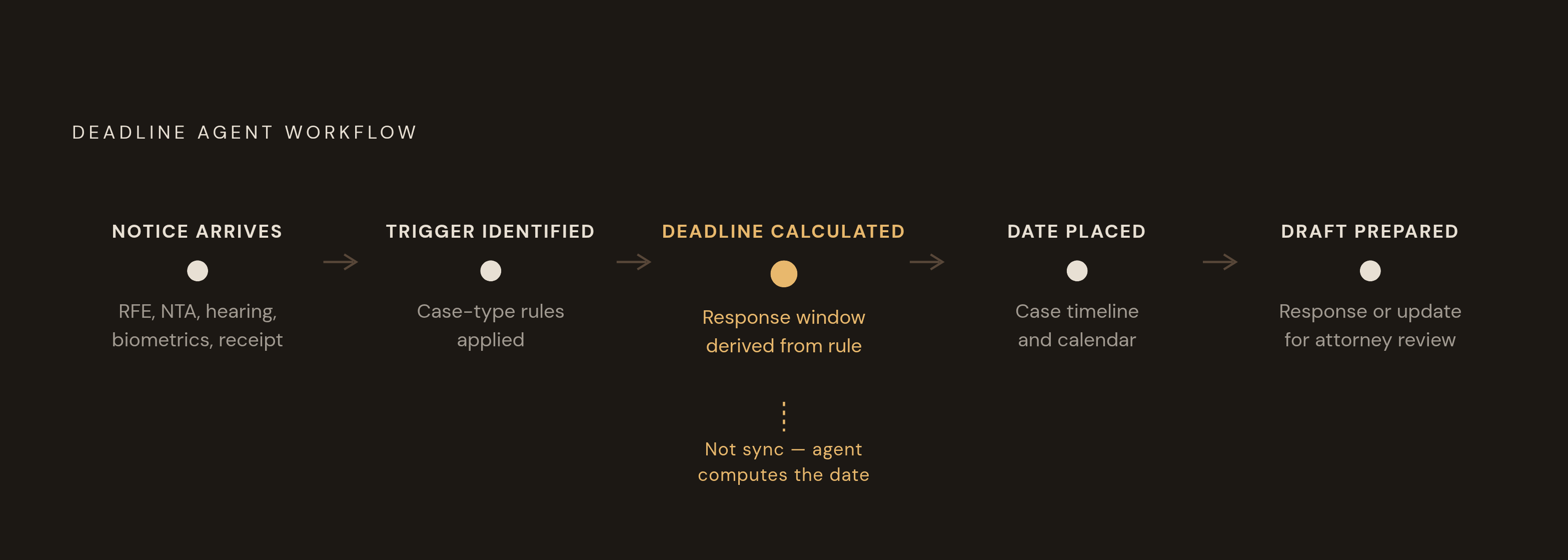
A deadline agent handles the reading, calculating, and calendaring while the attorney makes the legal judgments. The workflow begins when a notice arrives. CaseAgent describes reading RFEs, Notices to Appear, hearing notices, biometrics notices, and receipts, then identifying the triggering event and applicable rule. The agent places the resulting date on the case timeline and calendar and prepares a response or status update for attorney review and signature. A caseload view shows what is due across open cases that week.
An RFE illustrates how the steps connect. The agent reads the notice, calendars the response date, and drafts a first response organized around the evidence the officer requested. In removal proceedings, hearing dates and motion cutoffs from the relevant notices enter the case timeline. The asylum filing window needs a different intake path because the clock starts with the client’s last entry, without a new letter or notice. Calculating it at intake brings a notice-free clock into the same workflow.
Other case types need checks at each stage. CaseAgent describes priority-date checks against the visa bulletin and family-petition checklists from I-130 through adjustment or consular processing. Its naturalization workflow covers N-400 eligibility calculations through the interview date while keeping the document checklist current. LegistAI describes flagging the risk of missing a deadline when it takes too long to gather documents or hear back from a client. Mitratech describes predictive alerts for document submission dates, visa renewals, and other milestones. These functions address preparation risk before the final date approaches, while scheduled reminders to the client and staff address the separate risk that the person expected to attend remains uninformed.
How the tools in this category differ from each other in practice
General-purpose chatbots, including ChatGPT, Claude, Gemini, and Microsoft Copilot, support brainstorming, strategy, summaries, and general drafting. They are not immigration-specific docket systems. Consumer tiers raise confidentiality concerns, and general drafts require structural reformatting before filing. Their usefulness for language work should not be confused with ownership of a deadline workflow. Producing an answer about a notice is different from keeping its date connected to a live case.
Embedded case management AI works closer to the record. Docketwise offers the DocketWise IQ Document Assistant, which extracts names, dates, and key details from documents into USCIS forms within an immigration-focused platform. MyCase IQ provides writing, translation, and summary tools for emails, notes, and case summaries. Mitratech INSZoom provides configurable workflows, automated reminders, digital file assembly, expiration and deadline alerts, and automated data entry and form filling. Those functions span different portions of intake and administration, so an AI label alone does not establish automatic deadline calculation.
Research platforms serve a different need again. Thomson Reuters’ CoCounsel and Lexis+ AI help firms do deep research across large legal corpora, with broad coverage that goes beyond immigration and suits firms that do a lot of litigation or work in several areas of law. CaseAgent, in early access in 2026, describes a workflow that reads notices, drafts responses from the record, calendars dates, and prepares client updates for signature, with pricing planned per firm. Most firms will need complementary categories for case administration, substantive petition and RFE drafting, and precedent or policy research, while separately establishing which system actually calculates deadlines.
What it takes to move a deadline agent from pilot to production in a live docket environment
For a firm ready to deploy, production readiness begins with tested guardrails, monitoring, access controls, rollback procedures, and defined success metrics. A successful demonstration is not enough evidence. An agent’s non-deterministic output, producing different deadlines from the same notice, undermines the testing and accountability assumptions on which the docket depends. Reliable operation must be established with real users and data before broad delegation.
Task-level assessment defines the limits of that delegation. Extracting a date from a structured USCIS notice belongs to a different readiness class from reasoning about asylum strategy. The deployment design should identify which tasks the agent can own reliably and which require human review. It should also define when approval is required before an entry reaches the calendar, how ambiguous notices are escalated, and what happens when the model or provider is unavailable. Failure paths need owners before failures occur.
A dedicated function, distinct from IT and the business unit, can centralize ownership of evaluation frameworks, production monitoring, and response. The NIST AI Risk Management Framework organizes this work around Govern, Map, Measure, and Manage. The firm still has to connect governance to the concrete tasks, exceptions, and fallback procedures within its docket.
How to evaluate a deadline agent before committing a live docket to it
The firm should first check whether the product calculates deadlines from case-type rules or only synchronizes dates that staff enter. It should identify which notice types are parsed automatically and which still require manual entry. For ambiguous or damaged notices, the vendor should explain whether the system flags the document for review or can fail silently. These distinctions determine how much of the intake burden actually moves to the agent.
The next questions concern correction and continuity. The vendor should explain the rollback procedure for a missed or miscalculated deadline and whether calendar events remain linked to the underlying case record when dates change. The firm should check whether reminders reach clients as well as internal staff and whether their timing changes with the deadline type. Caseload visibility should be tested across the whole firm. A tool that requires opening every case to discover what is due preserves a manual bottleneck.
The firm should spell out its confidentiality requirements before client data goes into the system. The baseline includes encryption in transit and at rest, clear retention terms, and no training on client data. USCIS’s official processing times tool provides current, form-specific processing benchmarks, but those estimates are distinct from notice-specific response deadlines and cannot alone establish their accuracy. An AI Operations Audit before deployment can assess strategy, data, infrastructure, governance, security, people, and processes. It should uncover gaps, including tasks given to an agent that cannot do them reliably.
How to measure whether a deadline agent is working once it is live
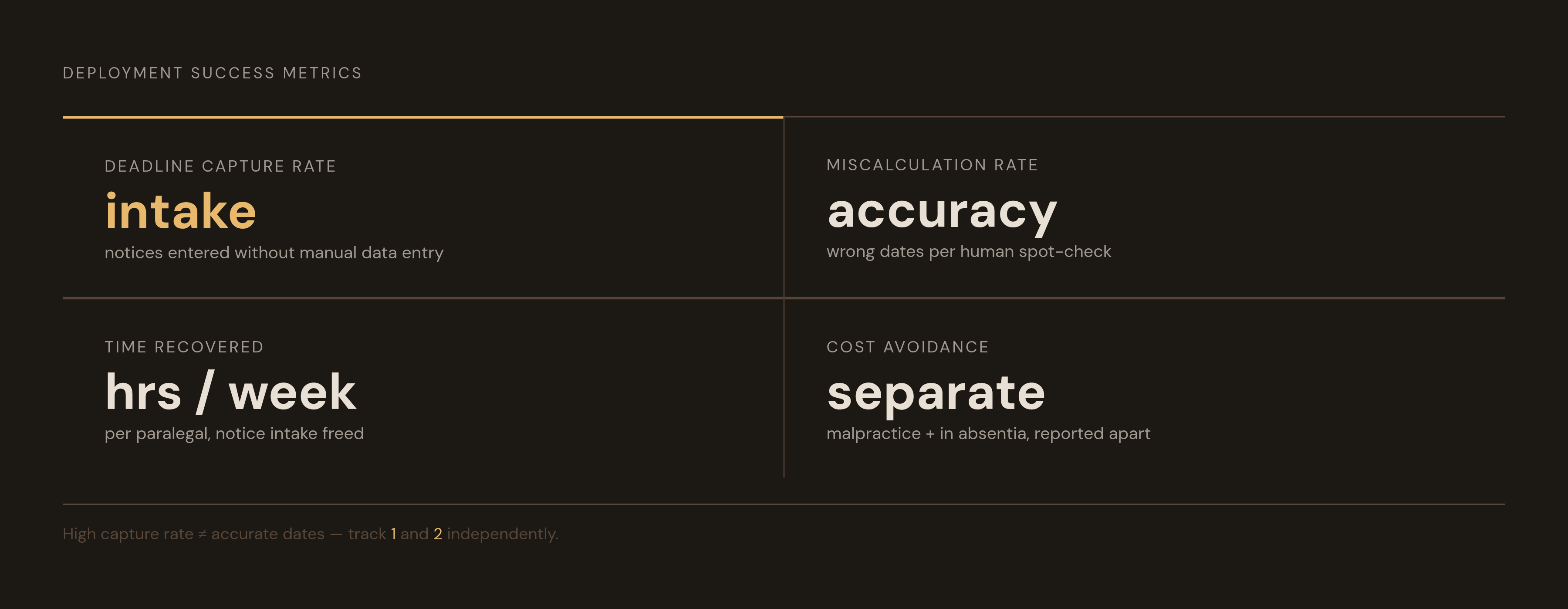
Deadline capture rate is the share of incoming notices that get a calendar entry without a person entering the data. It is the primary measure of intake reliability. Miscalculation rate shows how often the calculated date is wrong, based on human spot-checks against the source notices. The firm must track these measures separately because an agent can capture a notice and still get its date wrong. A busy calendar is not evidence of accuracy.
Time recovered per paralegal per week measures hours no longer spent opening notices, calculating dates, and retyping them into calendars. Capacity leverage measures how staff use the hours they get back. The second figure requires tracking independently of the first. Cost avoidance, including malpractice claims not incurred and in absentia orders not triggered, should also be reported separately from reductions in run-rate spending. CFOs need those distinctions because each claim requires a different basis of support.
Deployments that a firm configures or buys usually pay for themselves sooner than fully custom builds, so the time to payback matters when the firm decides whether to build or buy. A firm should anchor the engagement to an ROI target and keep measuring capture accuracy, calculation accuracy, recovered time, and capacity after launch. The agent’s continued place in the docket should depend on those results.